

It might seem daunting, time consuming & prohibitive for smaller practices, to implement BIM. Not with Driving Vision!

Before Work begins on a hospital extension, the project team faces an important decision: how should it build?
The existing hospital must remain operational. Deliveries must respect emergency access. Installation must fit within limited working areas. The completed extension must provide safe, dependable spaces for patients and healthcare professionals.
The team considers manufacturing room modules, wall panels, and service assemblies offsite. Digital models could help coordinate connections before production. Surveying equipment could verify the existing building’s dimensions. Planning tools could connect manufacturing, deliveries, and installation.
Modern methods and tools create value when teams organize them around the project's needs.

A Construction method describes how teams produce and assemble the building. A tool helps them carry out, coordinate, or verify that Work.
Panelized Construction, for example, uses manufactured wall, floor, or roof panels assembled on site. Supporting tools might include modeling software, automated cutting equipment, surveying instruments, and lifting systems.
This distinction matters. Buying software does not establish an effective manufacturing process. Selecting modular Construction does not automatically resolve design coordination or delivery constraints.
Leaders must connect the method, the tools, and the people responsible for the Work.
Prefabrication allows teams to manufacture components and assemblies before installation. These can range from structural elements to coordinated service racks.
Panelized Construction organizes Work around two-dimensional elements. Volumetric modular Construction goes further by producing three-dimensional units, potentially including internal finishes and services.
On the hospital extension, the team might use prefabricated service assemblies to coordinate pipework, ventilation, and electrical containment before delivery. Alternatively, complete room modules might suit parts of the building.
The choice depends on design requirements, repetition, manufacturing capacity, transport restrictions, and site access.
Factory production can support consistent working conditions and repeatable processes. However, moving work offsite also moves decisions earlier. Teams must resolve dimensions, connections, tolerances, and inspection requirements before manufacturing begins.
An unresolved decision can travel from the drawing into every component produced from it.
Digital design and coordination tools help specialists examine how components fit together. Clash detection can highlight physical conflicts, while construction-sequence simulations help teams explore installation order.
Surveying tools provide another essential connection. Laser scanning and precise measurement help teams compare design assumptions with existing conditions.
For the hospital extension, this could reveal that a connection point differs from the original drawings. Discovering the discrepancy before manufacturing gives the team a chance to adjust the design.
Factory tools then translate agreed information into physical components. Computer-controlled cutting equipment, assembly jigs, and automated machinery can support repeatable production.
On site, cranes, lifting frames, and positioning equipment support assembly. Their requirements must influence the design and delivery plan from the beginning.
The tools form a connected process. Their usefulness depends on how well information flows between stages.

Manufacturing and installation teams need to know which information is approved, what has changed, and who has authority to make decisions.
This is the practical role of Information Management.
A shared digital environment helps, but people must establish the rules governing its use. Someone must review a proposed change, assess its consequences, approve the revision, and ensure affected teams receive it.
On the hospital project, a change to a service connection could affect the factory assembly, the receiving structure, and the installation sequence. Updating a model is only one part of the project. Reliable information allows people to act with confidence.
Robotics, 3D printing, sensors, and AI expand the range of available tools. Their suitability depends on the task.
Robotic equipment may support repetitive manufacturing or site activities. Additive manufacturing produces elements layer by layer. Sensors can provide evidence about equipment or environmental conditions. AI can help teams examine documents, images, and patterns in project information.
These capabilities still require people to define the objective, assess the evidence, and decide what action to take.
A useful starting question is: Which specific problem should this tool help us solve?
Modern methods change when people contribute and what they need to understand.
Manufacturers need earlier involvement. Designers must consider production and assembly. Site teams need clear installation instructions. Maintenance teams should review access before components enter production.
For the hospital extension, an early discussion with maintenance staff might identify an inaccessible valve. Resolving it during design is easier than modifying a completed assembly.
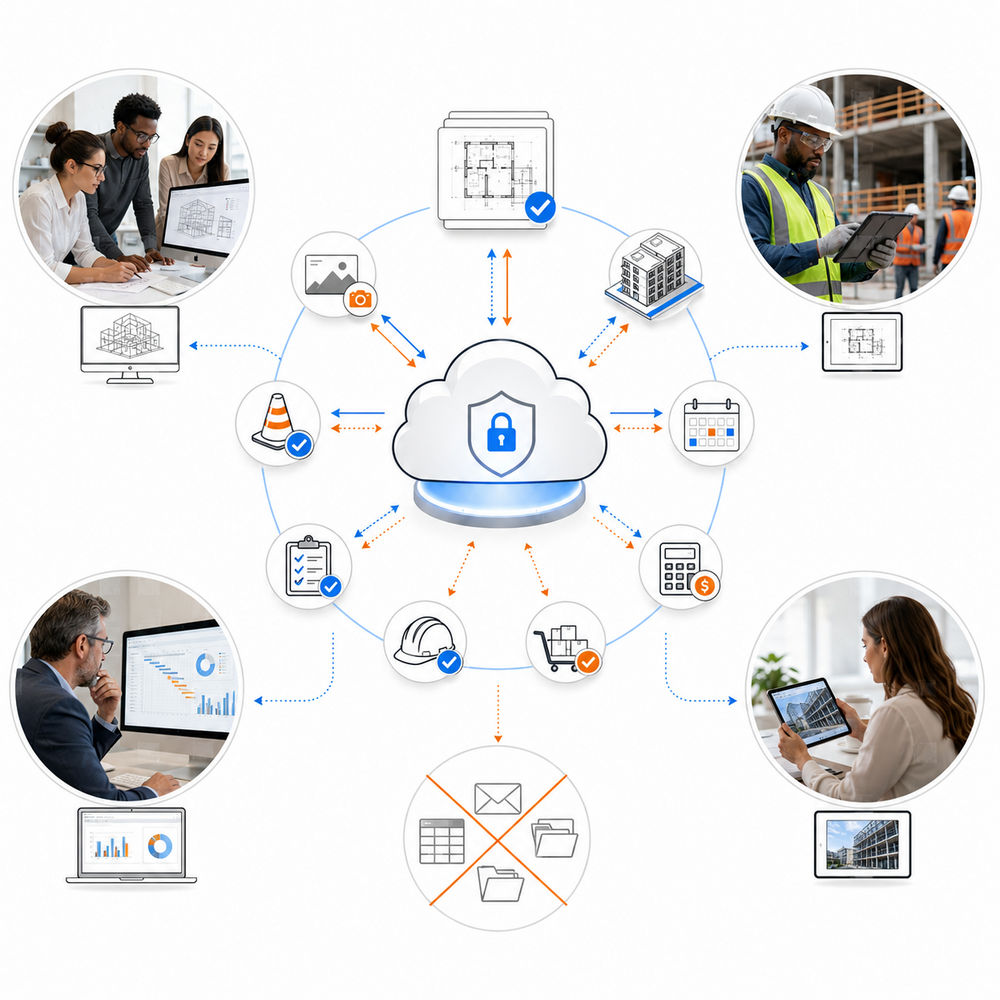
Collaboration makes the method workable.
Measuring What Improves helps teams agree on expected results before introducing a new approach.
They can then examine installation time, defects, waste, rework, delivery reliability, and overall cost against a clear baseline. Lessons from an initial application can guide the next one.
The opportunity in modern Construction is to connect better methods, reliable information, appropriate tools, and capable people into a dependable way of working.
That begins with an early decision about how to build—and a shared understanding of what successful delivery requires.
Where could a change in method make the greatest difference on your next project, and which tools would help your team put it into practice?
Implementing BIM can be daunting, but Driving Vision is here to help you at the pace you are comfortable with. Get started by getting in touch now
Of practices using BIM made positive ROI
Of practices using BIM improved health and safety
Of practices using BIM decreased errors and omission
Of practices using BIM enhanced their practice image
Of practices using BIM claimed less litigations
Of practices using BIM reduced rework
It might seem daunting, time consuming & prohibitive for smaller practices, to implement BIM. Not with Driving Vision!